FBC Areas
Form-Based Code Areas
Cleveland currently administers both conventional zoning and Form-Based Code. FBC applies only to properties that have been legislatively mapped into an FBC zoning district. Properties that remain conventionally zoned continue to be regulated under Cleveland’s conventional zoning regulations.
Not sure which zoning applies to your property? CHECK MY ZONING
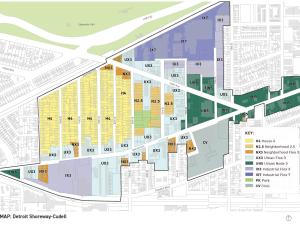
Detroit Shoreway & Cudell
| IN EFFECT- ORIGINAL PILOT (ADOPTED 2024) |
| On the near West Side, chosen for its proximity to Battery Park and the ongoing improvements to Edgewater Park. Anchored by the House 4 residential district, with an Urban Node 5 district planned at the Detroit & Lake intersection. |
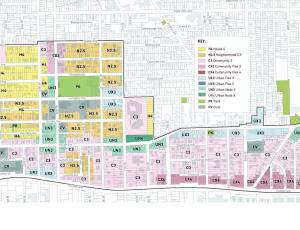
Hough
| IN EFFECT - ORIGINAL PILOT (ADOPTED 2024) |
| On the East Side, spanning the corridor along Chester Avenue between East 55th and East 90th Streets. Effective July 2024. Like Detroit Shoreway, House 4 is the primary residential building type used here. |
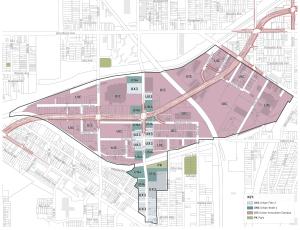
Opportunity Corridor & Job Core Zone
| IN EFFECT - ORIGINAL PILOT (ADOPTED 2024) |
| Covers land along the Opportunity Corridor between East 68th and Buckeye Road, and south of Cedar Avenue between East 93rd and Stokes Boulevard. |
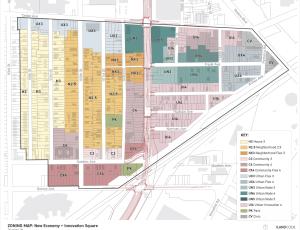
New Economy & Innovation Square
| IN EFFECT - ORIGINAL PILOT (ADOPTED 2024) |
| Covers the Innovation Square district near Fairfax and University Circle, extending the East Side pilot footprint along the "New Economy" corridor. |
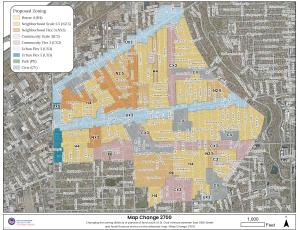
Housing Innovation District
| IN EFFECT (ADOPTED 2026) |
| Combines Hough, Central, and St. Clair-Superior into one zoning and permitting district aimed at spurring new housing development. |
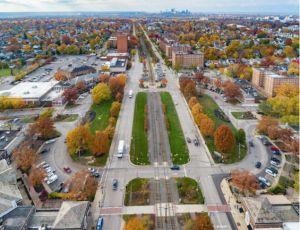
Shaker Square
| UNDER CONSIDERATION |
| A newly proposed pilot area under consideration for the form-based code rollout. Boundaries and building types have not yet been finalized. |
How are areas considered for FBC?
There is no automatic citywide conversion to Form-Based Code. Potential areas may emerge from neighborhood engagement, recent or adopted neighborhood plans, existing development patterns, major public or private investment, housing and redevelopment opportunities, and corridor or district planning.
Before zoning changes are adopted, residents and stakeholders have opportunities to participate through community engagement and the City’s legislative zoning process.
Changing Zoning Remains a Public Process
Before Form-Based Code is applied to a new area, the City considers neighborhood context, community input, planning recommendations, and investment opportunities, followed by a required legislative process.
1 | NEIGHBORHOOD INPUT Community engagement through meetings, discussions, and review of recent and adopted plans. |
2 | PLANNING AND ZONING ANALYSIS Evaluate existing conditions, neighborhood context, and opportunities. |
3 | PROPOSED FBC MAP Draft zoning districts and standards. |
4 | PUBLIC ENGAGEMENT Share the proposal and receive feedback from residents, property owners, and stakeholders. |
5 | CITY PLANNING COMMISSION Public hearing and recommendation. |
6 | CITY COUNCIL Legislative process and public hearings. |
7 | ADOPTED ZONING FBC district mapped and becomes effective. |
Project Timeline
DATE | EVENT |
2019 – 2023 | Code development and community engagement |
2023 – 2024 | Public review and legislative process |
July 2024 | Form-Based Code and initial FBC districts take effect |
2024 – Today | Cleveland administers both FBC and conventional zoning, evaluates implementation, and considers additional areas through planning, engagement and legislative map amendments |
Development Activity in Form-Based Code Areas
This map shows active permits within Cleveland’s Form-Based Code areas, highlighting where new development is occurring.