Lead Safe Ombudsman Office
The office helps people navigate city processes, understand program requirements, and address concerns when they have been unable to get answers through normal channels. The Ombudsman does not replace the work of departments such as Public Health, Building and Housing, Community Development, or Law. Instead, the office serves as an independent point of contact that can review concerns, facilitate communication, and help identify solutions.
Community members are encouraged to contact the Lead Safe Ombudsman if they have questions about Lead Safe Certification, concerns about delays or communication, disputes related to program requirements, or suggestions for improving the program. The Ombudsman can investigate complaints, help resolve conflicts between involved parties, and identify opportunities to improve policies and procedures.
Lead Safe Ombudsman Office Charter
To learn more about how the office works, you can see the charter in full below.
What Is the Lead Safe Ombudsman Office?
Mayor Bibb’s goal for the City of Cleveland’s Lead Accountability Team is “to strengthen coordination, increase accountability, and accelerate our progress toward safer homes for Cleveland families.”[1] In April 2026[2], the Lead Safe Cleveland Coalition reiterated a recommendation for the establishment of an Ombudsman who worked towards:
- Representing the interests of the public by investigating complaints of noncompliance with the Lead Safe Certification standards.
- Resolving disputes between parties including tenants, landlords, contractors, inspectors and the City.
- Recommending improvements in the Lead Safe Certification procedures, policies, and practices.
An ombudsman is an independent and impartial public official with authority and responsibility to receive, investigate or informally address complaints about government actions, and when appropriate, make findings and recommendations and publish reports.[3] The City of Cleveland moved forward with creating the ombudsman office in the summer of 2026.
The Lead Safe Ombudsman Office (LSOO) will serve as a public-facing resource to members of the community who are navigating concerns around lead safe housing.[2] The LSOO will not replace the roles and responsibilities of City Departments such as Public Health, Community Development, Building and Housing, or Law. Instead, it is a neutral office to investigate complaints and disputes, resolve inquiries, and suggest changes.
Here are some examples of the kinds of cases that might arise that the LSOO could handle:
- A dispute between a risk assessor and the Cleveland Department of Public Health staff about whether the submitted risk assessment met the standards for a Lead Safe Certificate.
- A call from a property manager who wants to know about the requirements to register a rental property with the City and hasn’t gotten a response from the number he previously called.
- A call from a Cleveland resident expressing frustration with how long he has been on the waitlist for a home repair program that accepted his application.
The remainder of this charter will go over how the LSOO operates and resolves cases like those listed above.
What Standards Govern an Ombudsman Office?
Ombudsman officers are organized through charters. Charters are agreements between organizations and their offices that codify roles and responsibilities and establish a shared understanding of how the office will function within the organization.[4]
Different offices use different standards. The LSOO will use the Governmental Ombudsman Standards[3] of the United States Ombudsman Association (USOA), and Recommendation 2016-5[5] of the Administrative Conference of the United States (ACUS). The LSOO operates under the three pillars of Independence, Impartiality, and Confidentiality.
Independence
An ombudsman office should be independent in structure, function, and appearance and free from outside control or influence to the greatest degree practicable.[3] More specifically, the office should:
- Report to an official at a high level of senior leadership at its organization to ensure adequate support. Under this standard, organizations should consider structuring offices so that they are perceived to have the necessary independence and are separate from other units of the organization.[5]
- Not have duties within the organization that might create a conflict with its responsibilities as a neutral party.
- Be given access to any internal information and records pertinent to its responsibilities.[5]
- Clearly articulate in all communications that it is independent and specifically not a conduit for notice to the organization in which it is located.
- Periodically evaluate its own office management and program effectiveness.
More broadly, the organization that the office belongs to should ensure that the physical ombudsman office, communication channels, and documentation systems enable discreet meetings and conversations.[5] Additionally, organizations should provide training to the staff of their ombudsman office with regard to standards and practice, whether offered by one of the ombudsman professional organizations or from within the government.
Impartiality
An ombudsman office should receive and review each case in an objective and fair manner, free from bias, and treat all parties without favor or prejudice. As the United States Ombudsman Association states, “the office is not predisposed as an advocate for the complainant nor an apologist for the government.”[3] No matter who submits a case, all cases should go through the same workflow. After impartial review, the office may advocate with regard to process by making recommendations.[5]
Confidentiality
An ombudsman office uses confidentiality as a tool.[3] An ombudsman may offer confidentiality and should communicate confidentiality boundaries at the beginning of the case. Moreover, the rules that apply at the beginning of the case should be applied throughout. However, government ombudsmen may be limited in the confidentiality that can be offered because of public records laws. A government ombudsman should be clear with people contacting the office about these limitations.[5]
How Do These Standards Apply to Cleveland’s Lead Safe Ombudsman Office?
The LSOO will strive to implement these standards within the context of lead safe housing work in Cleveland. We recognize that additional monetary resources may fix many problems, and that is one tool the LSOO does not have. That said, the office will endeavor to define clear pathways, clear outcomes, and clear communication with residents and members of the lead safe ecosystem.
Independence
In this charter, the office adopts the following standards in furtherance of the goals of Independence:
- The LSOO submits annual reports to the Mayor and quarterly reports to the Lead Safe Advisory Board. Those reports will aggregate case findings to highlight more systemic complaints, inquiries, and recommendations regarding the Lead Safe Certification law and the broader ecosystem surrounding it. The LSOO may track the implementation of these recommendations over time.
- The LSOO reports to the Director of Public Health for administrative and budgetary purposes.
- The LSOO reports to and communicates regularly with its designated supervisor within the Mayor’s Cabinet for training and evaluation purposes.
- The Mayor’s administration supports the LSOO in having access to all appropriate administrative levels within the City of Cleveland to obtain information necessary in the investigation and resolution of complaints and inquiries.
- The LSOO has discretion to prescribe how cases are to be reported, received, and acted upon, including the scope and manner of investigations and resolutions.[3]
- The LSOO has discretion to accept or reject matters for investigation, including the ability to review a matter on the office’s own accord.[3]
- The LSOO has discretion to determine which conclusions and recommendations are reached and incorporate those results into reports to the Mayor and Lead Safe Advisory Board. Reports will be provided in advance to the Mayor and Lead Safe Advisory Board, but changes may only be made at the decision of the LSOO.
Impartiality
In this charter, the office adopts the following standards in furtherance of the goals of Impartiality:
- The LSOO is a neutral reviewer and is not required to side with either the City of Cleveland or the person making a complaint.[3]
- The LSOO avoids actual conflict of interest (COI) and the appearance of COI.[3]
- The LSOO may recuse itself from involvement in cases where a COI or the appearance of a COI may exist.[3]
- The LSOO will not allow personal views on subject matter or involved parties to affect decisions about inquiries or case investigation or informal resolution.[3]
- The LSOO will periodically attend community events to increase accessibility to the LSOO and raise awareness of its purpose, standards, and procedures.
- The Lead Safe Ombudsman does not respond to media inquiries. Media requests should be sent to the Mayor’s Office of Communications and the Senior Advisor for Lead Accountability.
Confidentiality
In this charter, the office adopts the following standards in furtherance of the goals of Confidentiality:
- The LSOO will hold meetings in private offices with secure communication channels at Cleveland City Hall or Erieview Plaza.
- The LSOO will keep a documentation system that is independent of other departments at the City of Cleveland that work on lead.
- The LSOO’s materials are subject to typical public records requests. The office will de-identify case details in all public reports and inform involved parties that their communications may still be requested under public record laws.
- Where a question arises that requires an ethics inquiry, the LSOO will utilize the Ethics Office of the City of Cleveland’s Law Department.
- How Will the LSOO Operate Day-to-Day?
LSOO Workflow
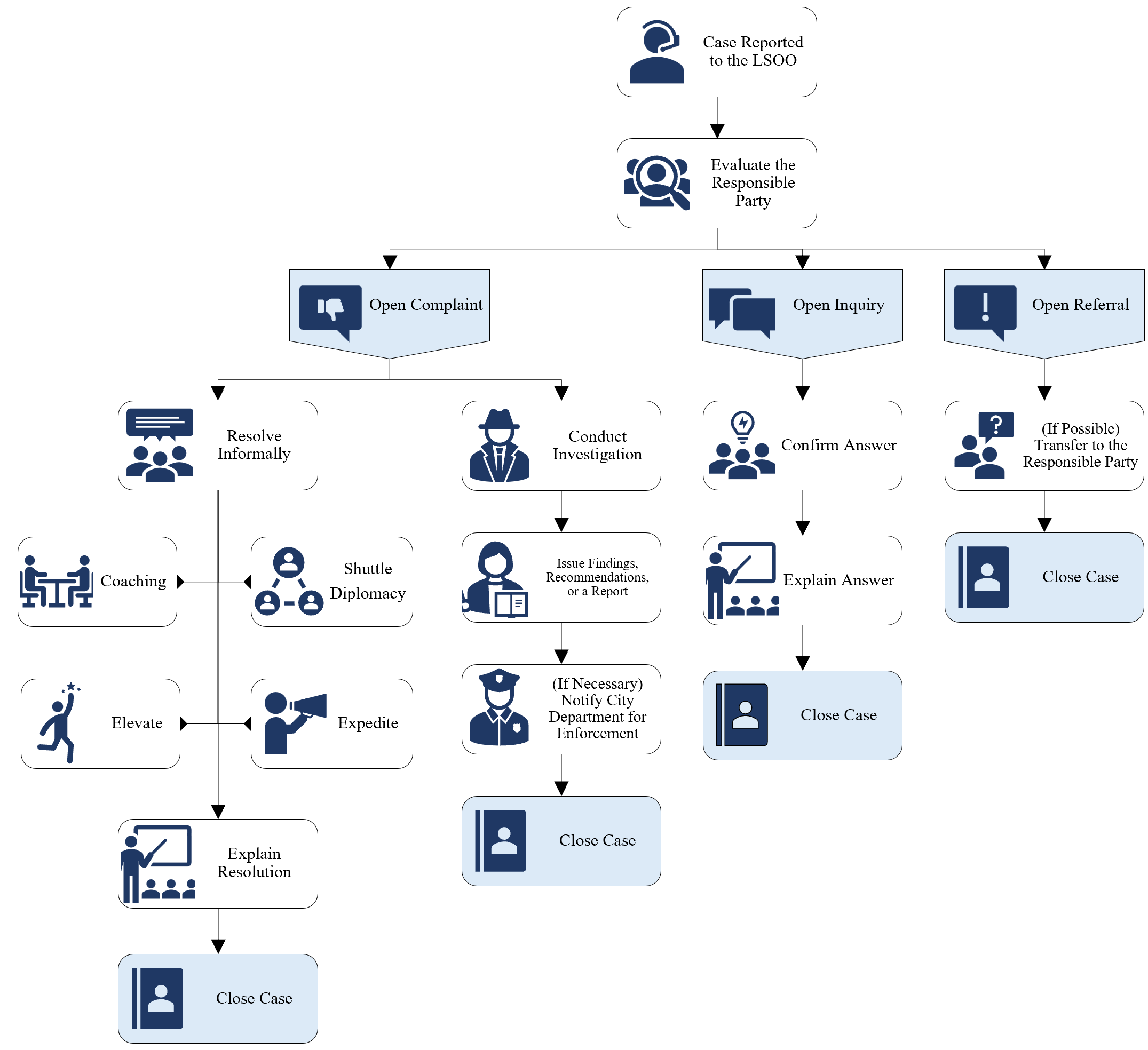
Cases Reported to the LSOO
Cases may be reported to the LSOO via phone call, email, or portal. These cases serve as the foundational data for the LSOO to issue publicly available annual reports to the Mayor and quarterly reports to the LSAB. The LSOO’s expectation is to acknowledge the reported case with the party involved within 1-3 business days and based on the case details, establish clear expectations on the timeline moving forward.
For a case to be considered as a complaint or handled as an inquiry, the subject of the complaint and ultimately, the responsible party must both be a part of the lead safe ecosystem. All complaints and inquiries do not need to be about Lead Safe Certifications; rather, they may be about the lead safe ecosystem. However, the LSOO must have sufficient authority, access, and resources to conduct an investigation, attempt informal resolution, or troubleshoot an answer to the inquiry. Depending on capacity constraints, the ombudsman may delegate power to an acting ombudsman[3] within the LSOO to open, investigate, resolve, transfer, and close cases.
- Open Case: a case that the LSOO is currently evaluating.
- Closed Case: a case that has reached a stage where no other assistance from the LSOO is necessary or possible. The LSOO will always give an explanation for the closure of the case to the parties involved. A case may be reopened with the presence of new and relevant information and at the discretion of the LSOO.
After documenting the case details, the LSOO will evaluate the responsible party and classify the case as a complaint, inquiry, or referral. The LSOO will then open said case and pursue closure.
Complaints
Complaints are expressions of dissatisfaction with a process and/or organization within the lead safe ecosystem. The LSOO will examine each complaint and either attempt informal resolution or conduct an investigation. The LSOO will consider factors such as whether the complaint raises serious concerns about safety or fairness, whether the subject has been given sufficient time to address the complaint, and whether the complainant has alternative avenues to remedy their complaint. Any complaints about the Lead Safe Ombudsman will be examined by the Senior Advisor for Lead Accountability.
Investigations
If the LSOO decides to investigate a complaint, it will update the complainant and subject of the status of the investigation every 2 weeks, unless otherwise specified in prior communication. The LSOO will issue findings, recommendations, or a more comprehensive report, depending on the case and the authority of the LSOO. The subject of the LSOO’s investigation will be notified of this and given the opportunity to respond in writing prior to the closure of the case. Notably, the findings, recommendations, and reports of the LSOO are not appealable, but the LSOO does not have enforcement powers.
Enforcement is left to the City Departments, who could review the information provided by the LSOO’s and decide to take action. For instance, if the investigation finds that a landlord failed to comply with the Lead Safe Certificate process, it would be the recommendation of the LSOO to pursue enforcement but up to Building and Housing to do so. If the investigation finds that a lead risk assessor took a landlord’s money and did not submit a lead risk assessment, it would be the recommendation of the LSOO for the Health Department to add this to their risk assessor quality control scorecard. But it is the responsibility of the Health Department to do so. After issuing a recommendation of enforcement, the LSOO may close the case. If the LSOO chooses not to issue findings, recommendations, or a report it will explain the reason why to the complainant and subject, pursue informal resolution, and then close the case.[3]
Informal Resolution
If the LSOO determines that an investigation is not necessary, it will use the strategies below to informally achieve case resolution. The LSOO may close a case if it can no longer be of practical assistance to a complaint or the parties involved. This list is not intended to be exhaustive. The LSOO approaches each complaint as a new and unique case, diagnosing the core issues and then prescribing an appropriate mechanism which best addresses the problem at hand and the needs of the parties involved. Regardless of the methodology employed, the LSOO operates at all times within the Standards of Practice outlined above.[6]
- Coaching: assist the party involved with understanding, applying for, and/or maintaining their Lead Safe Certification when they have been unable to resolve their complaint through regular City of Cleveland channels.
- Shuttle Diplomacy: negotiate resolution via ombudsman facilitation (where the ombudsman “travels” back and forth between two or more parties who are otherwise unwilling or unable to hold a direct conversation.) This could take place by phone, email, video conference, and/or in person.
- Elevate: raise the complaint to a supervisor within the organization.
- Expedite: prioritize consideration of the involved party’s complaint if they have experienced unreasonable delay.
Inquiries
Inquiries are questions about a process or organization within the lead safe ecosystem. Cases are classified as inquiries when the LSOO provides the information requested by the inquiring party and a complaint was not involved. Inquiry cases may be opened and closed on the same day if the LSOO has the answer to the inquiry readily available. That said, the LSOO will often confirm the answer with the responsible party and other relevant parties within the lead safe ecosystem before providing an answer and closing the case.
Referrals
Referrals are complaints or inquiries about a process or organization that falls outside of the lead safe ecosystem. Similarly, a case may be classified as a referral when it cannot be resolved with the LSOO’s resources. The LSOO will document the case details, transfer the case to a responsible party if possible, and then close the case.
What Are Some Typical Cases the LSOO May Handle?
Earlier in this charter, there were examples of a typical kind of case that the LSOO may receive. Each was based on a real case that was handled in this workflow. Here’s how each one was handled:
Complaint Example
A dispute between a risk assessor and the Cleveland Department of Health staff about whether the submitted risk assessment met the standards for a Lead Safe Certificate.
A risk assessor and a CDPH staff member had been going back and forth about the requirements to get a property lead-safe certified. Both parties were frustrated. The risk assessor felt like the standards kept shifting and the CDPH staff felt the Ohio Administrative Code (OAC) rules weren’t being followed. They opted in to a complaint process with the LSOO. The LSOO produced a report that evaluated the timeline of events and identified delays and challenges on both the CDPH end and the risk assessor’s end. The report made recommendations for how the risk assessment could become compliant and also recommended improvements to the city website and communication methods so that confusion over the OAC rule wouldn’t happen in the future.
Inquiry Example
A call from a property manager who wants to know about the requirements to register a rental property with the City and hasn’t gotten a response from the number he previously called.
A property manager called the LSOO and left a voicemail asking about the requirements to register a rental property with the city. The LSOO returned his call later that day and learned that the property manager had recently gone to City Hall to get a physical copy of the Rental Registration application as he likes to do things on paper and speak to people, face-to-face. The property in question did not have a Lead Safe Certificate. Moreover, the property manager did not know that having a Lead Safe Certification was a requirement for a Rental Registration or how to obtain a Lead Safe Certification.
The LSOO documented the case details and explained to the property manager the requirements and process for obtaining a Lead Safe Certificate as well as the option to submit his applications online. To close the case, the LSOO sent a follow-up email to the property manager reiterating the advice and action items discussed over the phone and included a link to the list of vetted Lead Risk Assessors from the Lead Safe Cleveland Coalition.
Referral Example
A call from a Cleveland resident expressing frustration with how long he has been on the waitlist for a home repair program that accepted his application.
A senior resident called the LSOO and left a voicemail expressing frustration with how long he had been on the waitlist for a home repair program that accepted his application. The LSOO returned his call later that day and learned that the resident was on the wait list for an HVAC repair with a third-party non-profit. The resident was not expecting lead repair, but had thought that all home repair went through the same number. The LSOO confirmed that the resident was not enrolled in a City program. The LSOO then obtained the resident’s permission to reach out to the non-profit about the case. The LSOO received confirmation that this resident is a client and also received confirmation from the non-profit that they would call the resident back with an update on the home repair work.
The LSOO made a note for future reports that phone numbers should better distinguish between responsible parties in home repair. The LSOO then closed the case.
Can the LSOO’s Standards or Charter Be Changed?
This is an interim charter and will be used to launch the LSOO. After 6 months it will be reviewed and edited by the Lead Safe Ombudsman with the agreement of the Senior Advisor for Lead Accountability and the Mayor. It will remain in effect unless revoked by the Mayor and the Senior Advisor for Lead Accountability.
Endnotes & Signatures
- City of Cleveland. "City of Cleveland Announces Former Councilwoman Rebecca Maurer as Senior Advisor for Lead Accountability." Press release, March 10, 2026.
- Lead Safe Cleveland Coalition, Policy Committee. Re: Lead Safe Certification Legislative Recommendations. 2026.
- United States Ombudsman Association. Governmental Ombudsman Standards. 2003.
- International Ombudsman Association. Best Practices: Ombudsman Office Charters.
- Administrative Conference of the United States. The Use of Ombuds in Federal Agencies. Administrative Conference Recommendation 2016-5. 2016.
- U.S. Department of Labor, Office of Federal Contract Compliance Programs. Ombuds Service Protocol. 2020. (PDF Available Upon Request)
Request Assistance
To request assistance, residents and stakeholders may contact the Lead Safe Ombudsman directly at 216-664-2035 or by using the form below. Please be aware that we maintain confidentiality as applicants request. However, like all communications to the City, these submissions may be subject to third party public records requests.