When a Child Tests Positive for Lead
When a child tests positive for lead, it can feel overwhelming and frightening for families. This section explains what happens next, who will support you, and the steps that help protect your child’s health and make the home safe again.
Understanding Lead Exposure and Protecting Your Family
Talk to your pediatrician, general physician, or local health agency about what you can do. Your doctor can do a simple blood test to check you or your child for lead exposure. You may also want to test your home for sources of lead.
There is no safe level of lead in the blood.
There are two types of blood tests: a capillary test and a veinous test. A capillary test can be done with a finger prick at your doctor’s office. A veinous test requires a blood draw. You can start with a capillary test, but it is the recommendation of the Ohio Department of Health to confirm all capillary tests with a veinous test.
The City of Cleveland recommends that all children are tested for blood lead levels at age 1 and age 2. Under Ohio law, doctors must order a blood test if any of the following conditions apply for children at ages 1 or 2:
- The child is on Medicaid?
- The child lives in a high risk ZIP Code? (See list below)
- The child lives in or regularly visits a home, child care facility or school built before 1950 The child lives in or regularly visits a home, child care facility or school built before 1978 that has deteriorated paint
- The child lives in or regularly visits a home built before 1978 with recent ongoing or planned renovation/remodeling The child has a sibling or playmate that had lead poisoning?
- The child frequently comes in contact with an adult who has a hobby or works with lead? Examples are construction, welding, pottery, painting and casting ammunition
- The child lives near an active or former lead smelter, battery recycling plant or other industry known to generate airborne lead dust
If one these conditions exist between ages 3 and 6 and there is no lead testing history, a lead test should be ordered.
Elevated blood lead: A vein blood test shows 3.5 to 9.9 mcg/dL (micrograms per deciliter)
Lead poisoning: A vein blood test shows 10 mcg/dL (micrograms per deciliter) or more.
If your child has elevate blood lead (the level is between 3.5 and 9.9 micrograms per deciliter), here’s what will happen:
- You’ll get a letter from the health department asking you to contact us.
- We’ll also reach out—either by phone or by visiting your home—to ask you a few simple questions. This takes about 10–15 minutes and helps us understand where lead hazards might be in your home..
- We can give you a cleaning kit and simple information about lead, how to clean to reduce lead dust, and foods that can help lower your child’s lead level.
If your child shows lead poisoning (lead levels are 10 micrograms per deciliter or more, the following things will happen:
- You will get a letter from the health department asking you to contact us.
- We will call you and visit your home to ask a few simple questions. Your answers help us decide which parts of the home need to be checked.
- After your inspection is scheduled, our team will come to your home to look for lead hazards. They will look around the home, take dust samples, take soil samples, and test painted surfaces.
- During the visit, we will give you a cleaning kit and easy tips on how to clean to reduce lead dust in your home.
- Before we leave, we will show you any areas that tested positive for lead.
- You will get a copy of the inspection report after all lab results come back.
- If we find lead hazards during the inspection, the home will be put under an order that requires the owner to fix those hazards. The owner will need to hire a certified lead contractor to do the work.
Yes! The Clark Fulton, St. Clair-Superior,Glenville, and Mount Pleasant neighborhoods stand out with the highest lead-poisoning rates. We recommend that all children in Cleveland get tested for lead but please be aware your child might be at a higher risk if you live in one of these neighborhoods.
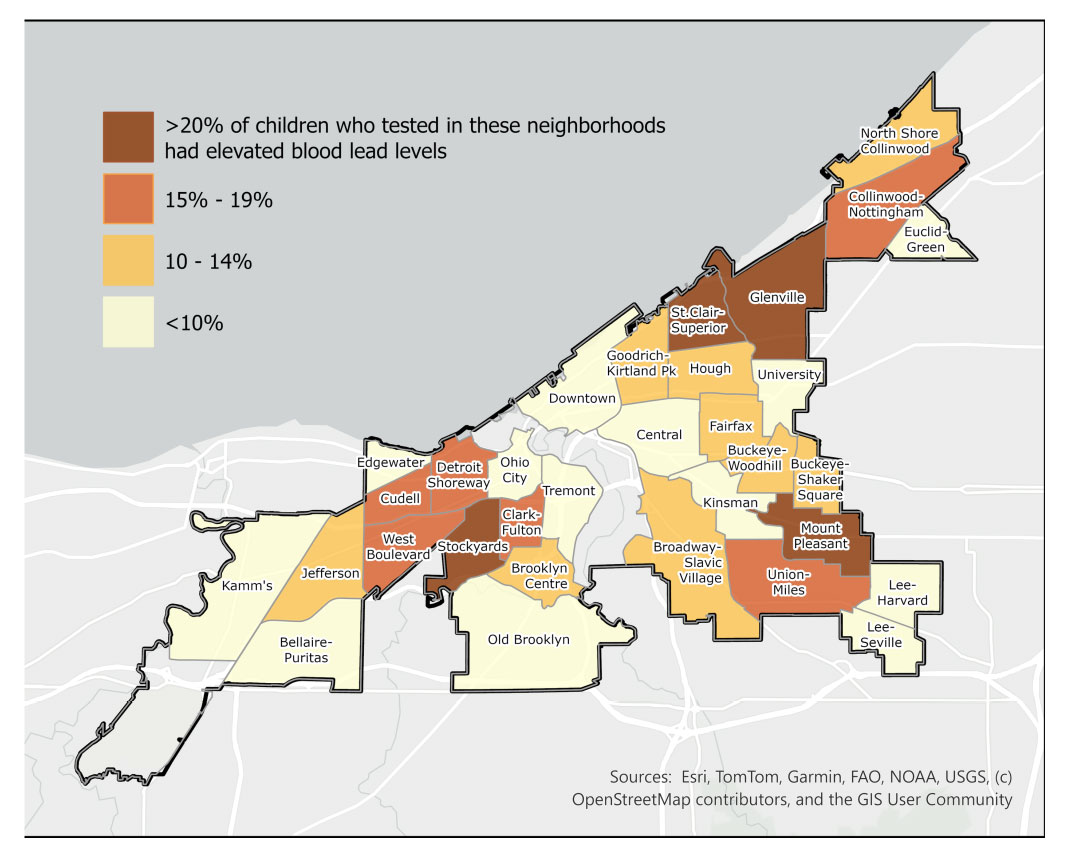
| Percent of children that were tested in each neighborhood with elevated (higher than normal) blood lead levels. |
| GREATER THAN 20%: Glenville, Mount Pleasant, St. Clair-Superior, Stockyards. |
| 15%–19%: Clark-Fulton, Collingwood-Nottinham, Cudell, Detroit Shoreway, Union-Miles, West Boulevard |
| 10%–14%: Broadway Slavic Village, Brooklyn Centre, Buckeye-Shaker Square, Buckeye-Woodhill, Fairfax, Goodrich-Kirtland Pk, Hough, Jefferson, North Shore Collinwood |
| LESS THAN 10%: Kamm's, Bellaire-Puritas, Old Brooklyn, Ohio City, Tremont, Edgewater, Downtown, Central, Kinsman, University, Euclid-Green, Lee-Harvard, Lee-Seville |
Requiring Blood Lead Testing for Ohio Children less than 6 Years of Age
Ohio Healthy Homes and Lead Poisoning Prevention Program
| 44101 | 44102 | 44103 | 44104 | 44105 | 44106 | 44107 | 44108 | 44109 |
| 44110 | 44111 | 44112 | 44113 | 44114 | 44115 | 44116 | 44117 | 44118 |
| 44119 | 44120 | 44121 | 44122 | 44123 | 44125 | 44127 | 44128 | 44129 |
| 44130 | 44131 | 44132 | 44134 | 44135 | 44137 | 44143 | 44144 | 44146 |
